Features: how the API collects and matches hotel rates
Collect, compare and monitor hotel rates from Google Hotels, the OTAs and rental sites, and the hotel’s own booking engine, through one API key and one credit meter. Who it is for and what it costs: the hotel price API.
- Google Hotels
- Booking.com
- Expedia
- Hotels.com
- Agoda
- Tripadvisor
- Airbnb
- Vrbo
- Hostelworld
- + over 50 hotel booking engines
Rates you can compare
The same room sells under different conditions on every site. The API labels each plan so you compare offers, not just numbers.
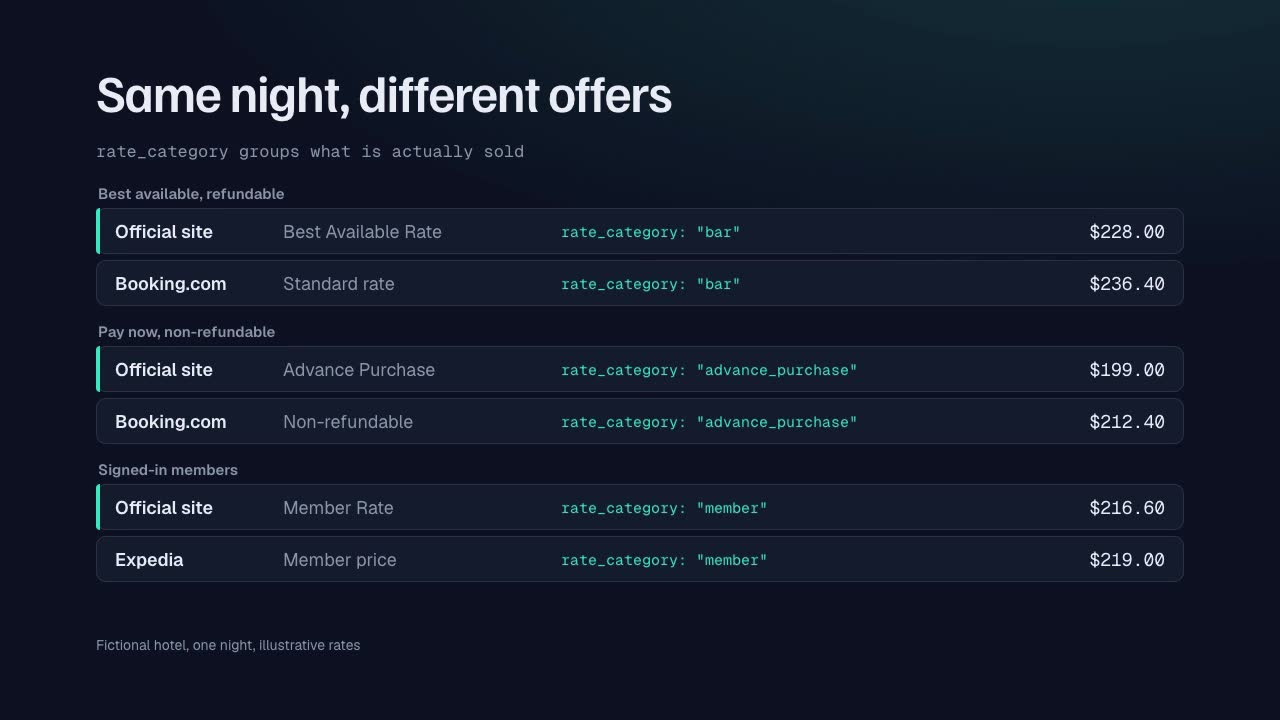
A normalised category on every plan
Each rate plan carries a rate_category, with rate_category_source saying how it was decided. Chain sites add the brand’s own rate_code, andrefundable and meal_plan where the brand states them.
- bar
- rack
- advance_purchase
- member
- points
- package
- promo
- qualified
- unknown
Qualified rates on request
Ask for qualified_rates (aaa, senior,government) where the hotel’s engine offers them. They come back labelledrate_category: "qualified", never count as the public price, and add 1 credit per type searched.
Member and loyalty prices are labelled and kept out of the headline cheapest rate, so it stays comparable with what a signed-out guest sees on an OTA. rate_code_scope (room orproperty) says what a rate code is attached to.
50+ official booking engines, detected for you
Give a hotel’s website and the API follows the booking link, identifies the engine and returns the rates a guest can book there. New engines are added regularly.
Prices that keep their parts
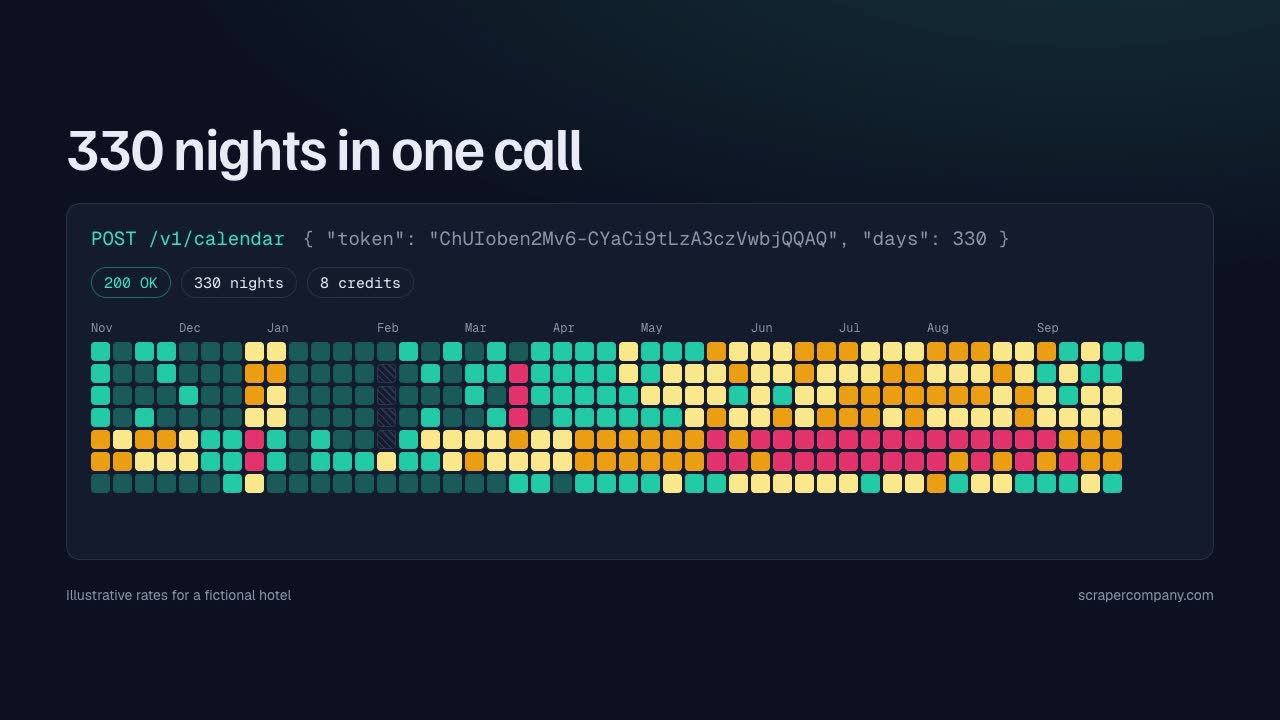
Calendars return up to 330 nights per call (90 by default), with base, taxes, fees and total kept apart, and the provenance of each night.
{
  "stay_date": "2026-12-31",
  "rate_base": 332.01,
  "tax": 67.47,
  "fees": 25,
  "rate_total": 424.48,
  "currency": "USD",
  "market": "US"
}/v1/calendar answer, from the public spec."provenance": {
"schema_version": 1,
"observation_id": "rateobs_0123456789abcdef0123456789abcdef",
"collection_id": "ratecol_0123456789abcdef0123456789abcdef",
"observed_at": "2026-08-07T01:23:45.678Z",
"source": "google_hotels_calendar",
"source_kind": "calendar",
"source_property_id": "ChUIoben2Mv6-CYaCi9tLzA3czVwbjQQAQ",
"requested_market": "US",
"requested_currency": "USD",
"returned_currency": "USD",
"price_basis": "room_base_before_taxes_and_fees",
"derivation": "normalized_upstream"
}The collection work, handled
Reliability
Parsing, retries and the upkeep behind each source are handled on our side. When a site changes its pages, extraction falls back to other paths and checks the result before it is returned. A 4xx or 5xx response or an empty page costs 0 credits, and every response reports what it charged in x-credits-charged.
How we keep the data flowingComp sets as one job
Send a whole comp set as one job and collect every calendar when it is ready.
Built for code
A REST API with typed request schemas, a public OpenAPI spec for code generation, examples in cURL, Python and Node.js, and x-api-key authentication. Every request, and the response it returned, can be opened in your dashboard.
The hotel APIs
Each source has its own page with the fields it returns, an example and what a call costs.
- Google Hotels API
- Booking.com API
- Expedia API
- Hotels.com API
- Agoda API
- Tripadvisor API
- Hotel Reviews API
- Hotel Direct Rates API
Every call has a fixed credit price. See plans and what each call costs
What teams build with it
- Rate parity monitoring
Is an OTA undercutting our direct rate?
- Competitor rate shopping
What will our comp set charge for the next 90 nights?
- Review monitoring
What are guests saying about us, and are we replying?
- Metasearch & booking apps
Can we show live hotel prices without building scrapers?
- Flight price tracking
When is the cheapest day to fly this route?
- Vacation rental pricing
What do comparable Airbnb and Vrbo listings charge?
- AI travel agents
Can our agent quote real hotel and flight prices?
- Rate-code matching
Are we comparing the same rate on every channel?
Start with 50 free calls
Create an account and verify your email: your own API keys and a free trial of 50 calls or 14 days, whichever ends first, no card needed. Then buy a credit pack from $15 or pick a plan from $49 a month.
7,500 credits, one-time. No subscription. Or try it free: 50 calls, no card.
- See pricingPlans, packs and every price
- Talk to salesVolume, custom terms, invoices
- Read the quickstartFirst call in five minutes